Change one feature and suddenly the entire face can look different. That is exactly why rhinoplasty—or the classic “nose job”—has fueled some of the most dramatic before-and-after transformations in plastic surgery.
A smaller bump, slightly different tip or narrower bridge can change the balance between the nose, lips, eyes and chin without turning someone into a completely different person. And in 2026, that subtlety is increasingly the point.
From traditional nose surgery and preservation rhinoplasty to revision procedures and the controversial “liquid nose job,” here is what rhinoplasty actually changes, what it cannot do and why everyone from celebrities to TikTok users keeps talking about noses.
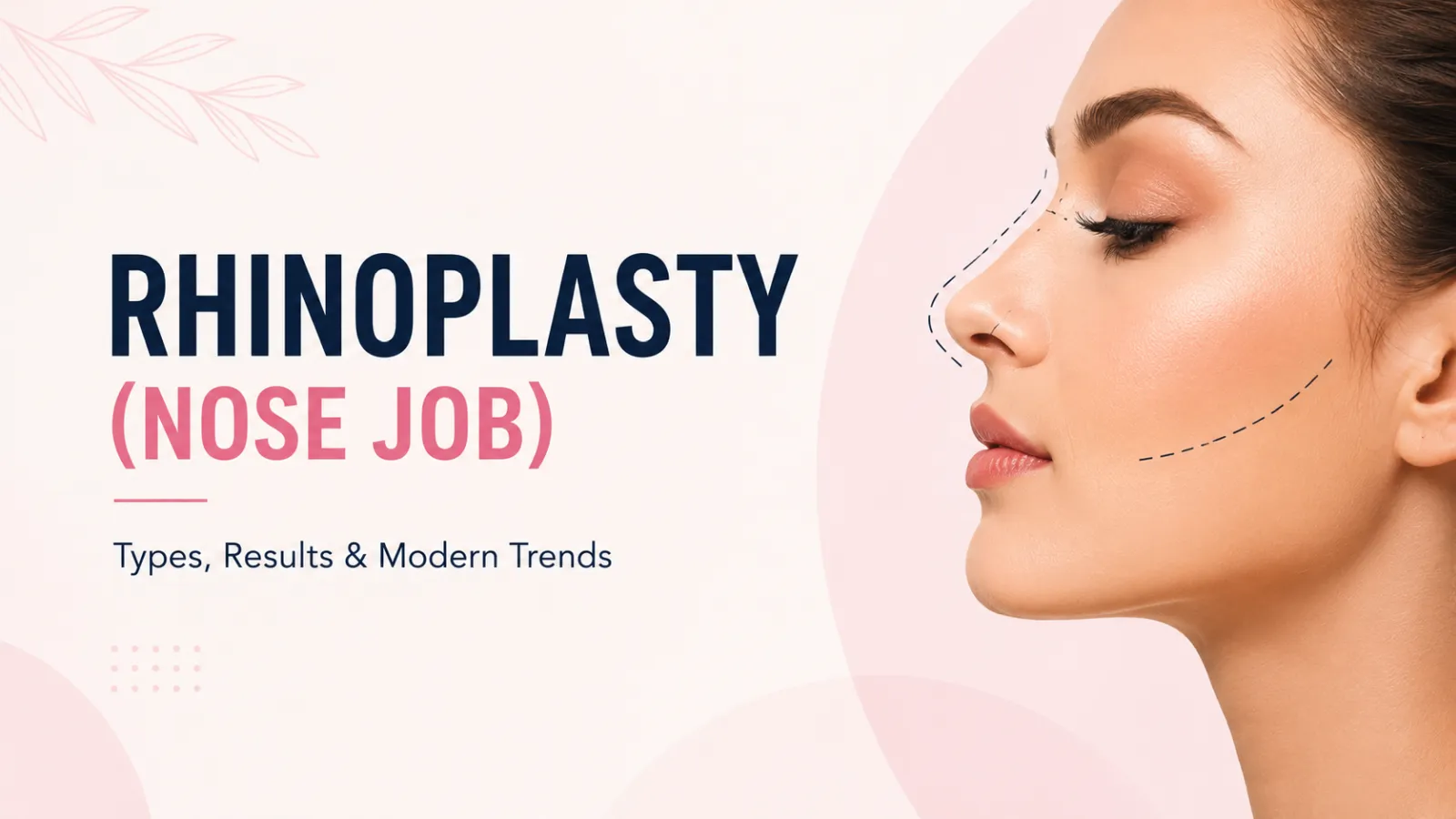
What Is Rhinoplasty—and What Does a Nose Job Actually Change?
Rhinoplasty is surgery that changes the shape, proportions or structure of the nose. It can be performed purely for appearance, to improve breathing caused by structural problems, or to address both at the same time.
In everyday language, it is simply a nose job. But that nickname makes the procedure sound much more basic than it really is.
Rhinoplasty can potentially change:
- The bridge – including a visible bump or depression.
- The nasal tip – making it more refined, lifted, reduced or reshaped.
- Nose width – particularly through the bridge or nostril area.
- Nostril size or position.
- Overall nose size in relation to the rest of the face.
- Asymmetry or certain visible irregularities.
- Internal structure when breathing problems are involved.
What makes rhinoplasty especially fascinating is that the goal is not necessarily to create the smallest or straightest possible nose. The real aesthetic game is facial balance.
A nose that looks fantastic on one face could look completely wrong on another. That is one reason the cookie-cutter “Instagram nose” has increasingly given way to more individualized results.
Cosmetic vs. Functional Rhinoplasty: It Isn’t Always Just About Looks
Cosmetic rhinoplasty primarily changes appearance, while functional rhinoplasty focuses on structural problems that interfere with breathing. A single operation can sometimes address both goals.
Someone might want a prominent hump softened while also having an internal obstruction corrected. Same nose, two very different reasons for surgery.
- Cosmetic rhinoplasty: focuses mainly on appearance and facial proportions.
- Functional rhinoplasty: focuses mainly on airflow and structural problems.
- Combined rhinoplasty: addresses appearance and function during the same overall procedure.
A deviated septum is one common reason breathing enters the discussion. Surgery involving correction of the septum is often referred to as septoplasty, while surgery combining nasal reshaping with functional correction may be described as septorhinoplasty.
This distinction also matters when people casually say someone “had their nose done for medical reasons.” That statement does not automatically tell you whether appearance was changed too.
What Are the Main Types of Rhinoplasty?
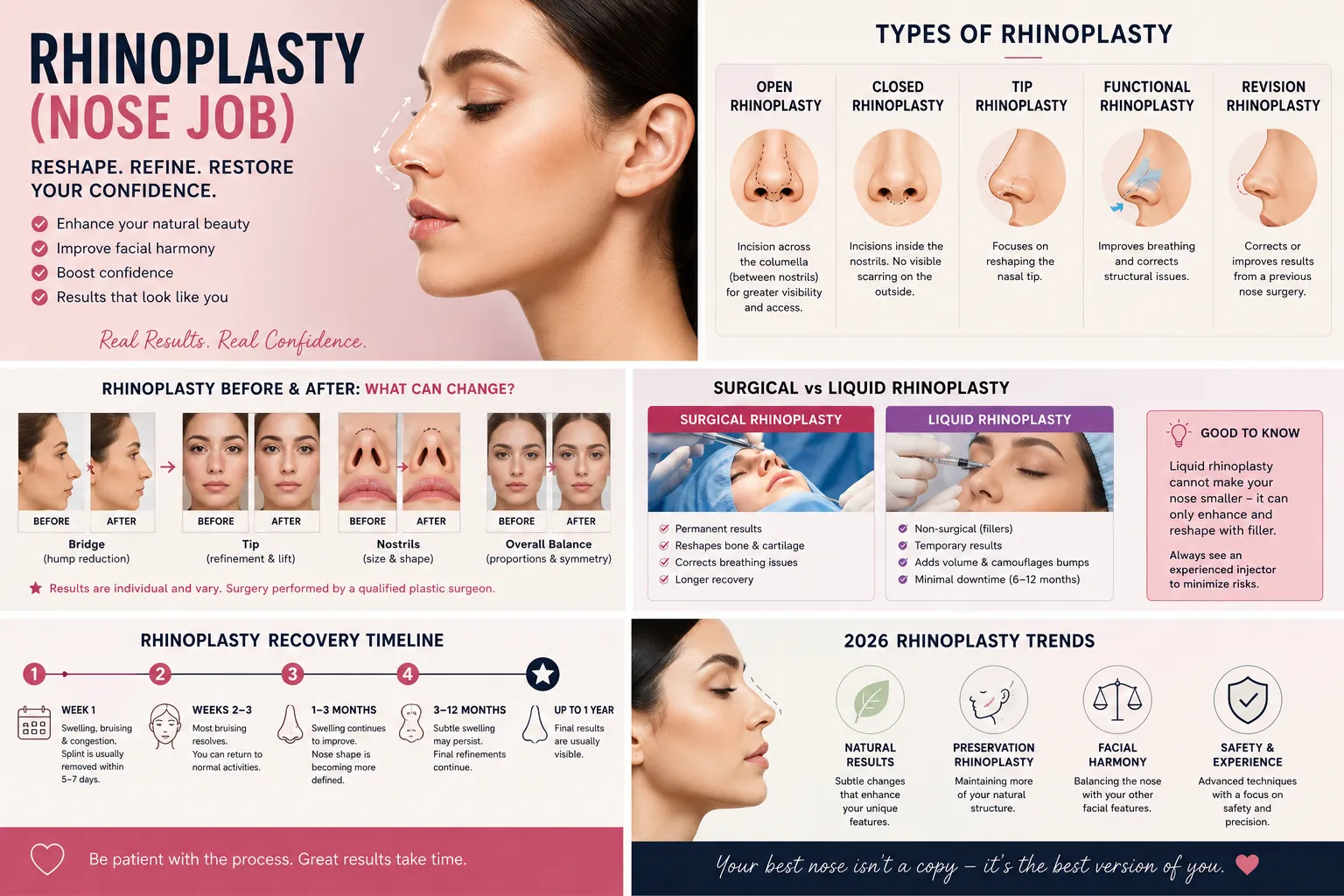
Rhinoplasty can be classified by how the surgeon accesses the nose, what is being changed and whether it is the patient’s first nose operation. That is why two people who both say they had a “nose job” may actually have undergone very different procedures.
The terms you are most likely to encounter include:
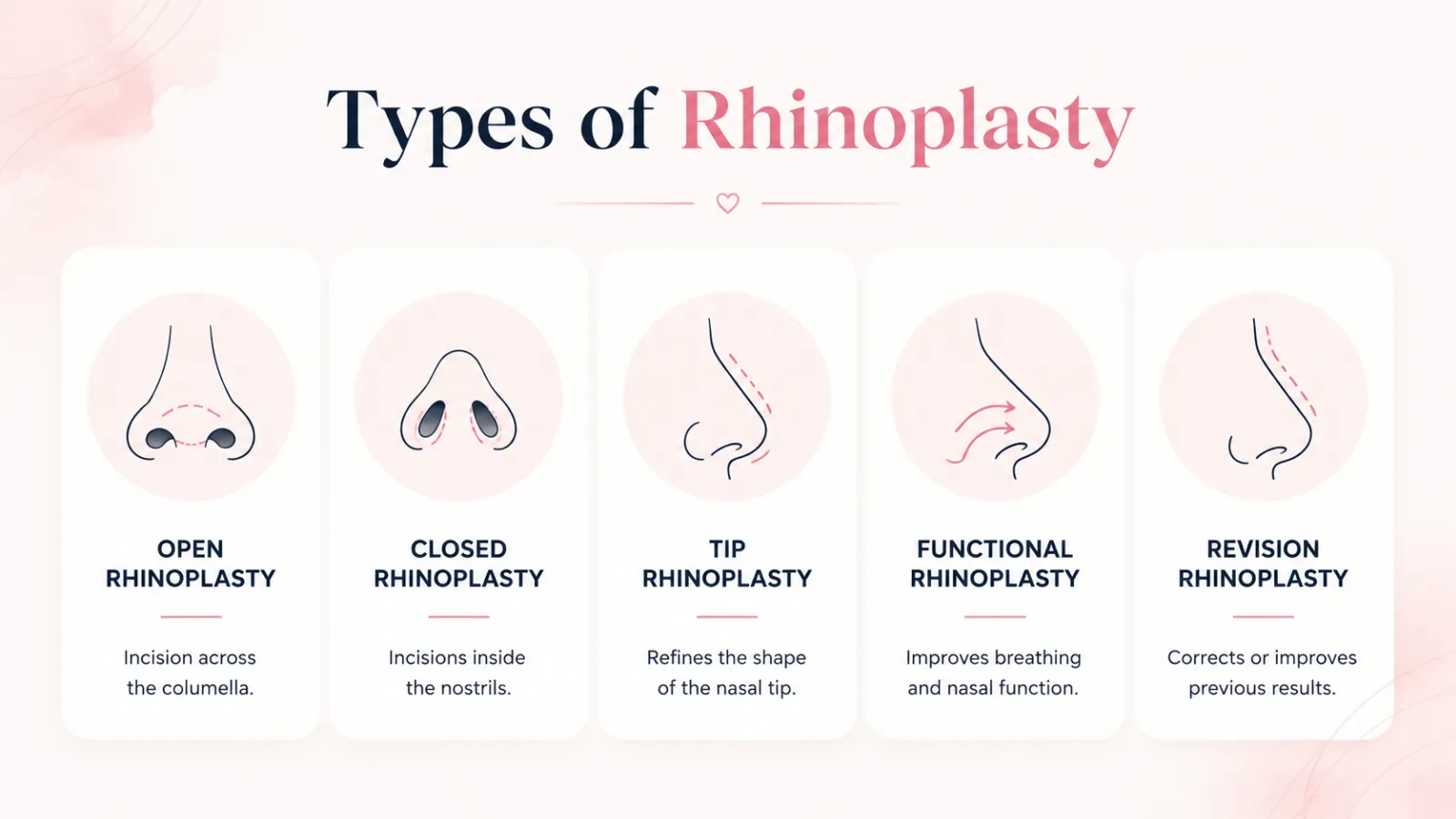
Open Rhinoplasty
Open rhinoplasty involves an external incision in the tissue between the nostrils so the underlying structures can be more directly exposed. It can provide greater access when more extensive reshaping is planned.
Closed Rhinoplasty
Closed, or endonasal, rhinoplasty uses incisions inside the nostrils. There is no external incision between the nostrils, although not every desired change is best suited to this approach.
Primary Rhinoplasty
Primary rhinoplasty simply means the patient’s first rhinoplasty procedure. The nasal structure has not previously been altered by another nose job.
Revision Rhinoplasty
Revision or secondary rhinoplasty is performed after a previous rhinoplasty when additional changes are wanted or needed. Scar tissue and previously altered cartilage can make these cases more complicated than first-time surgery.
Tip Rhinoplasty
Some nose jobs focus heavily on the nasal tip rather than making major changes to the entire nose. A tip might appear bulbous, drooping, wide or overly projected before reshaping.
Functional Rhinoplasty
This approach concentrates on structural changes related to breathing and airflow. Cosmetic refinements may sometimes be combined with functional work.
Then there are newer or newly fashionable labels—one of which has become particularly hard to miss.
What Is Preservation Rhinoplasty—and Why Is Everyone Talking About It?
Preservation rhinoplasty aims to reshape the nose while keeping more of its original bone, cartilage and supporting anatomy intact. The buzz around it fits perfectly with today’s preference for noses that look refined rather than obviously operated on.
The idea is not actually brand new. What is new is how heavily the word preservation now appears in conversations about modern rhinoplasty.
Instead of automatically dismantling and rebuilding major structures, preservation-based techniques try to retain more of what is already there when the individual nose allows it.
Potential goals include:
- Maintaining more of the nose’s original anatomy.
- Creating a subtle rather than over-operated appearance.
- Keeping recognizable individual characteristics.
- Avoiding an excessively pinched or scooped look.
- Achieving better facial harmony without screaming “nose job.”
But preservation rhinoplasty is not automatically better rhinoplasty. Some noses require changes that make a more traditional approach more suitable.
The broader trend is more interesting than the label itself: people increasingly want to look like an improved version of themselves, not like they ordered someone else’s nose from a catalog.
Natural Rhinoplasty Is Winning the 2026 Nose Job Trend
The biggest modern rhinoplasty trend is toward natural, individualized results that are difficult to identify as surgery. The ultra-small, aggressively scooped nose is no longer the only aesthetic people are chasing.
ASPS reported that nose reshaping grew around 2% in 2024, making it one of the facial procedures showing the strongest growth that year. The same report described demand for subtle, natural-looking and “undetectable” facial results.
That philosophy has only become louder heading into 2026.
Current aesthetic buzzwords include:
- Natural rhinoplasty
- Preservation rhinoplasty
- Facial harmony
- Profile balancing
- Subtle refinement
- Ethnic feature preservation
- Undetectable plastic surgery
In practice, that could mean leaving a little character rather than sanding every distinctive feature away. A perfectly straight miniature nose is not necessarily the perfect nose for every face.
And that makes modern before-and-after comparisons more interesting. The best result may be the one where you notice the face looks better before you notice exactly what changed.
Rhinoplasty Before and After: Why a Small Nose Change Can Transform a Face
Rhinoplasty before-and-after photos can look dramatic because the nose sits at the visual center of the face and strongly affects facial proportions. A relatively small adjustment can change how the eyes, lips, chin and profile appear in relation to one another.
The side profile usually makes changes easiest to spot. A dorsal hump, downward-pointing tip or strong projection can look very different once the bridge and tip have been reshaped.
Front-facing photos can reveal other changes:
- A narrower-looking bridge.
- A more refined tip.
- Different nostril width.
- Improved visible symmetry.
- A change in how wide or prominent the nose appears.
But this is exactly where internet plastic-surgery detective work can go off the rails.
Makeup contouring, focal length, head position, lighting, weight changes and photo editing can all change the apparent shape of a nose. Compare a telephoto red-carpet portrait with a close-up phone selfie and you may be looking at two surprisingly different versions of the same feature.
That is why a celebrity rhinoplasty rumor should remain a rumor unless the celebrity has confirmed surgery or another reliable source establishes it. “Her nose looks smaller” is an observation—not an operating-room record.
Celebrity Nose Jobs: Why Rhinoplasty Rumors Never Die
Rhinoplasty is one of the most frequently speculated-about celebrity procedures because older and newer photographs make nose changes relatively easy to compare. One different bridge or tip is enough to launch a thousand side-by-side posts.
Hollywood also gives us unusually long visual timelines. For some celebrities, there are high-resolution photographs covering their teens, twenties, thirties and beyond.
That creates irresistible before-and-after material:
- Child star vs. adult celebrity.
- Early-career red carpet vs. current appearance.
- Pre-fame photos vs. polished Hollywood styling.
- Profile comparisons years apart.
- Confirmed nose jobs vs. long-running fan speculation.
The important distinction is confirmed vs. suspected. Some celebrities openly discuss rhinoplasty, while others deny surgery or simply never address the rumors at all.
And sometimes the internet changes its verdict every few years. Yesterday’s “obvious nose job” becomes tomorrow’s makeup tutorial once enough new photographs appear.
What Is a Liquid Rhinoplasty or Non-Surgical Nose Job?
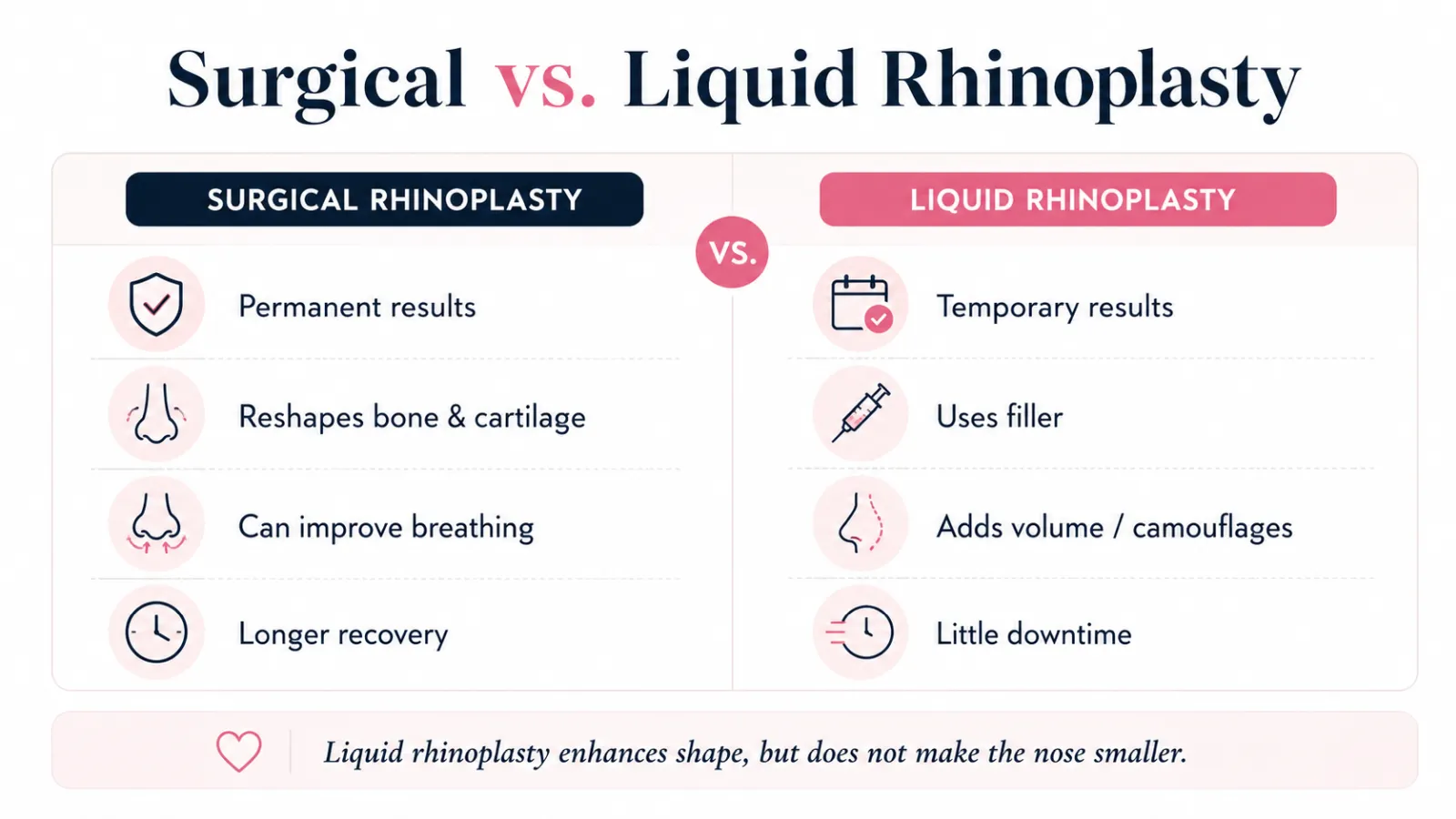
A liquid rhinoplasty uses injectable filler to temporarily alter the appearance of the nose without traditional surgery. It can add volume or visually camouflage certain contours, but it cannot literally shrink the nose or provide the same structural changes as surgical rhinoplasty.
This is the paradox of the so-called non-surgical nose job: filler works by adding material. Clever placement can make a bump look less obvious or create the illusion of a straighter profile even though nothing has been removed.
A liquid rhinoplasty may be used for certain goals such as:
- Smoothing the visual appearance of a small hump.
- Adding definition to selected areas.
- Creating the appearance of a straighter bridge.
- Making temporary cosmetic adjustments without surgery.
It is not simply “rhinoplasty without the scary part,” though. The nose contains an important network of blood vessels, making filler injections in this area particularly sensitive.
ASPS specialists interviewed in 2026 specifically noted that accidental filler injection into a blood vessel can cause serious complications, including skin injury and, rarely, vision loss. Results are also temporary rather than permanent.
So surgical and liquid rhinoplasty may share a nickname, but they are not interchangeable procedures.
How Long Does Rhinoplasty Recovery Really Take?
The obvious early recovery from rhinoplasty is measured in weeks, but the nose can continue refining for many months and final contour may take around a year to become fully apparent. In other words, the splint comes off long before the nose is truly finished changing.
Swelling is the plot twist people underestimate.
The first weeks usually produce the biggest visible changes as swelling decreases. After that, refinement becomes much more gradual, and subtle swelling can linger or fluctuate.
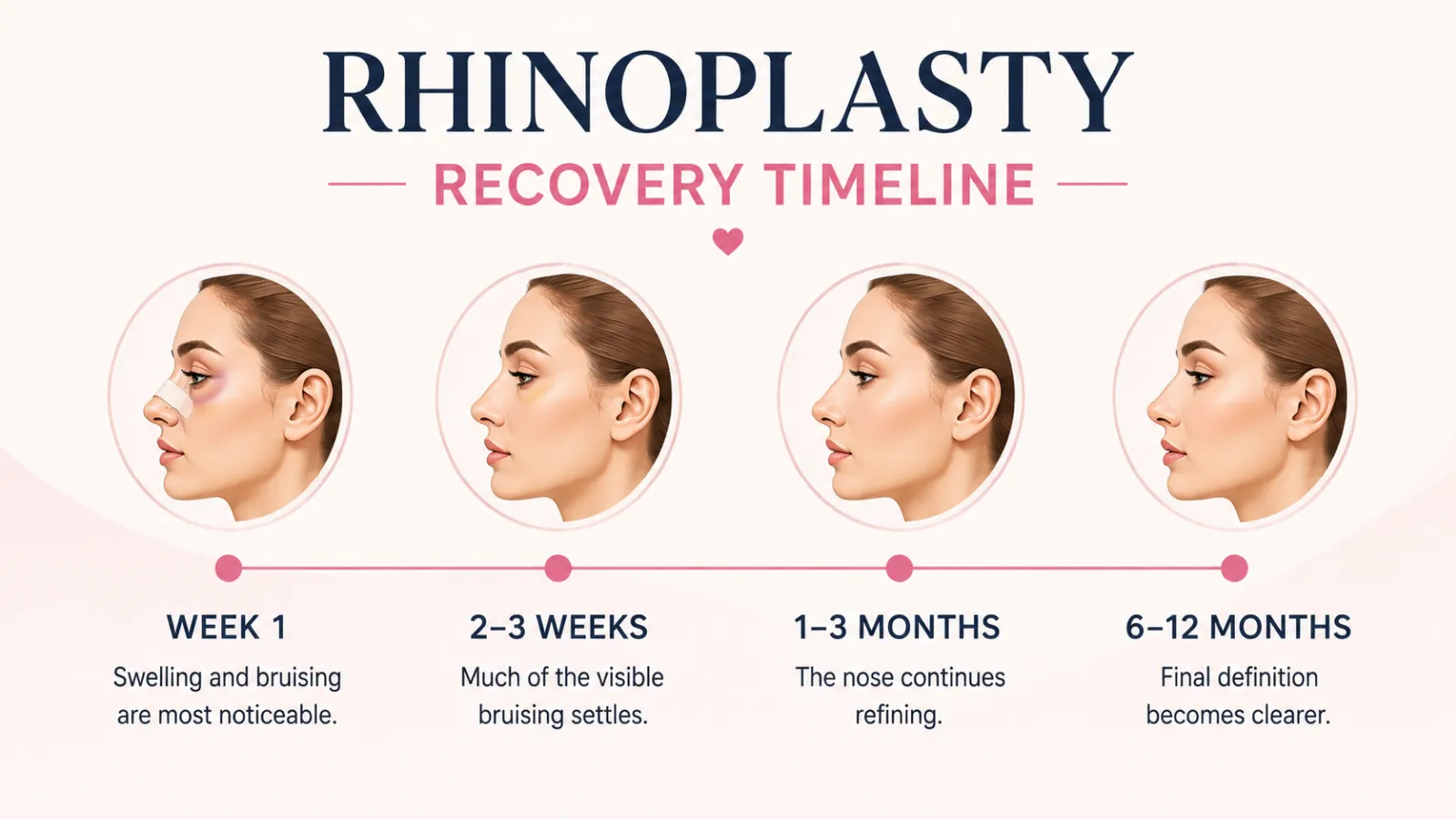
A rough recovery timeline can look like this:
- First week: splinting, swelling and bruising are commonly most noticeable.
- Following weeks: much of the obvious swelling begins settling and appearance becomes more socially presentable.
- Following months: the nose gradually becomes more defined as residual swelling continues to decrease.
- Around one year: the final contour may be much easier to judge.
This is worth remembering when looking at viral rhinoplasty before-and-after images. A result photographed six days after surgery and one photographed twelve months later are not remotely the same comparison.
Patience is not glamorous, but with rhinoplasty it is part of the reveal.
How Much Does Rhinoplasty Cost?
Rhinoplasty pricing varies widely depending on the surgeon, location, complexity and type of operation. The latest ASPS 2024 fee data projects U.S. surgeon or physician fees for nose reshaping at roughly $7,500 to $12,500.
That figure should not be confused with an all-inclusive checkout price.
Potential parts of the total bill can include:
- Surgeon’s fee.
- Anesthesia.
- Operating room or facility charges.
- Preoperative testing.
- Prescriptions and aftercare.
- Additional expenses related to the individual case.
Revision rhinoplasty can also be a different pricing proposition because previously altered anatomy and scar tissue may make the operation more complicated.
When rhinoplasty is purely cosmetic, insurance generally does not cover it. When surgery is performed to correct a documented breathing problem, some functional portions may potentially be treated differently depending on the insurance plan and circumstances.
Can Rhinoplasty Go Wrong?
Yes. Rhinoplasty can produce unwanted cosmetic results or medical complications, and some patients ultimately undergo revision surgery. The fact that nose jobs are common does not make every result predictable.
Possible problems listed by the American Society of Plastic Surgeons include:
- Difficulty breathing.
- Infection.
- Changes in sensation.
- Persistent swelling or discoloration.
- Scarring or healing problems.
- Nasal septal perforation.
- An appearance the patient is unhappy with.
- The possibility of additional revision surgery.
Then there is the purely aesthetic version of “something looks off.” A nose can technically heal while still looking too pinched, overly rotated, unnaturally narrow or simply out of balance with the rest of the face.
This is also why rhinoplasty mistakes can be unusually visible. The nose sits directly in the middle of every conversation, selfie and driver’s-license photo.
A good nose job can disappear into the face. A bad one can become the first thing you see.
The modern nose job in one sentence: Rhinoplasty is increasingly less about creating the same “perfect nose” for everyone and more about making carefully chosen changes that leave the face looking balanced, recognizable and—ideally—not obviously operated on.
Rhinoplasty FAQ
Is rhinoplasty the same as a nose job?
Yes. “Nose job” is the everyday term commonly used for rhinoplasty or nose reshaping. Rhinoplasty can change appearance, nasal structure or both.
Can rhinoplasty make your nose smaller?
Rhinoplasty can reduce or reshape portions of the nose and change how large it appears in relation to the face. The exact changes depend on the person’s existing anatomy and the surgical plan.
Can a nose job remove a bump?
Reducing or reshaping a prominent bridge or dorsal hump is a common rhinoplasty goal. Modern approaches may alter the bridge using different techniques depending on the anatomy and desired result.
How long does rhinoplasty last?
Surgical rhinoplasty results are generally long-lasting. The face and nose can continue changing naturally with age, but most of the surgical change is intended to remain.
When can you see the final rhinoplasty result?
Major swelling improves earlier, but ASPS says it may take up to about a year for the nasal contour to fully refine. That means early before-and-after photos should never be mistaken for a finished result.
What is preservation rhinoplasty?
Preservation rhinoplasty aims to reshape the nose while retaining more of its existing bone, cartilage and supporting structure. It has gained renewed attention as interest in subtle and natural-looking nose jobs has increased.
What is revision rhinoplasty?
Revision rhinoplasty is another nose operation performed after a previous rhinoplasty. It may address cosmetic concerns, functional issues or both.
Can rhinoplasty improve breathing?
Yes, when nasal structure is contributing to obstructed airflow. Rhinoplasty may incorporate functional changes intended to improve breathing in addition to—or instead of—cosmetic reshaping.
Is liquid rhinoplasty permanent?
No. A liquid rhinoplasty uses filler and produces temporary rather than permanent changes. ASPS experts interviewed in 2026 described typical results as lasting roughly six months to one year.
Can you tell whether a celebrity had rhinoplasty from photos?
Photos can reveal changes in appearance, but they cannot prove that surgery caused them. Camera angles, makeup, lighting, age, editing and other factors can create convincing differences between two images.
The Nose Job Isn’t Disappearing—It’s Getting Harder to Spot
Rhinoplasty remains one of the defining procedures in facial plastic surgery, but the aesthetic target is changing. Instead of asking for an obviously smaller or dramatically sculpted nose, many people now appear to be chasing something harder to describe: a nose that simply looks like it always belonged on that face.
That is why modern rhinoplasty before-and-after photos can range from jaw-dropping transformations to comparisons where you need several seconds before spotting what changed.
Explore more of our guides to plastic surgery procedures, facial treatments and cosmetic trends—or dive into our celebrity plastic surgery before-and-after stories to see why rhinoplasty remains one of the internet’s favorite transformation mysteries.