
For decades, breast augmentation was practically synonymous with one idea: go bigger. In 2026, that rulebook is being rewritten.
Breast augmentation is still one of America’s most popular cosmetic surgeries, but today’s conversation is increasingly about proportion, smaller implants, subtle upper fullness, fat transfer and results that don’t immediately announce, “Yes, I had a boob job.”
From silicone and saline breast implants to fat transfer and the new obsession with the so-called “ballerina breast,” here is what breast augmentation can actually change—and why bigger is no longer automatically considered better.
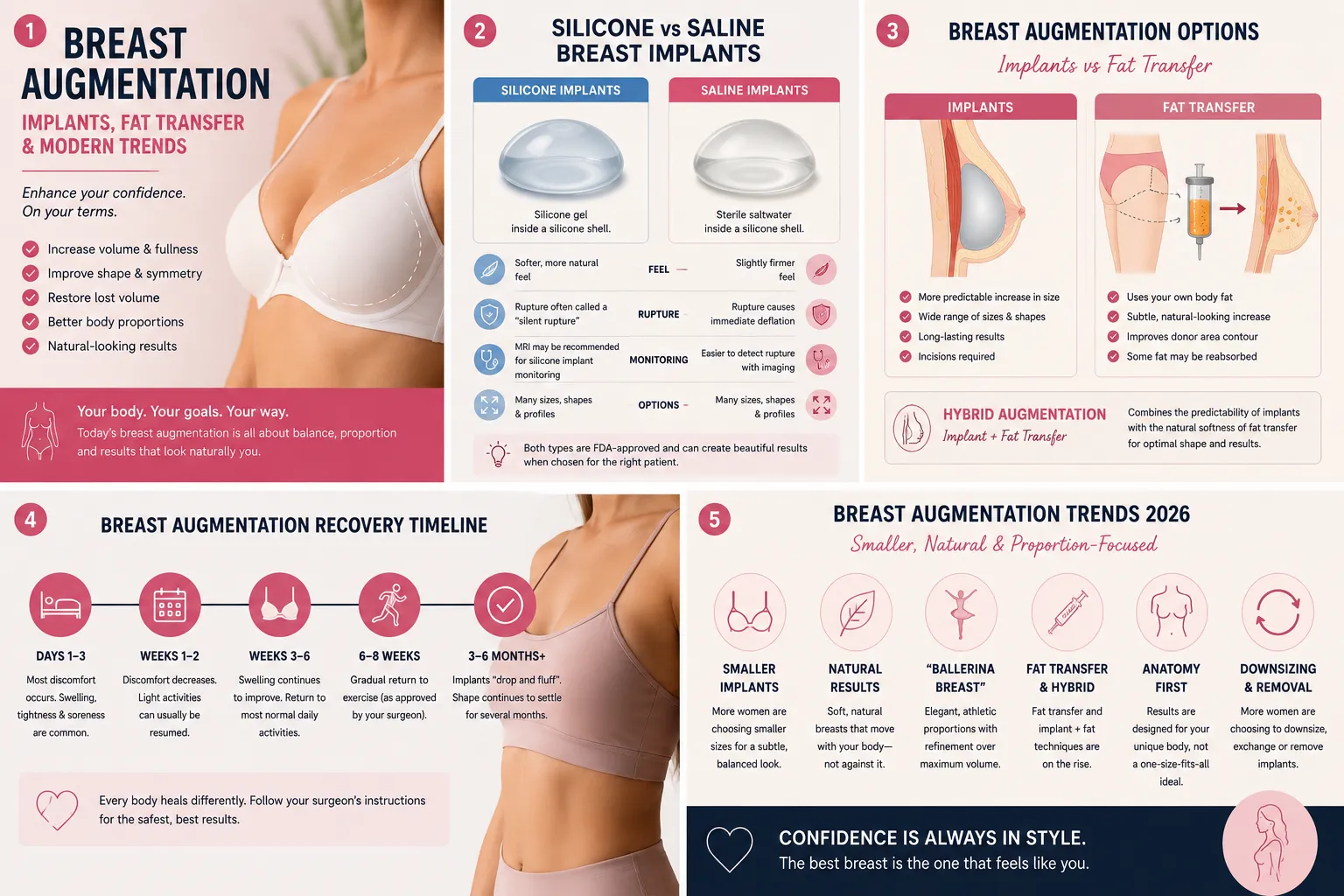
What Is Breast Augmentation?
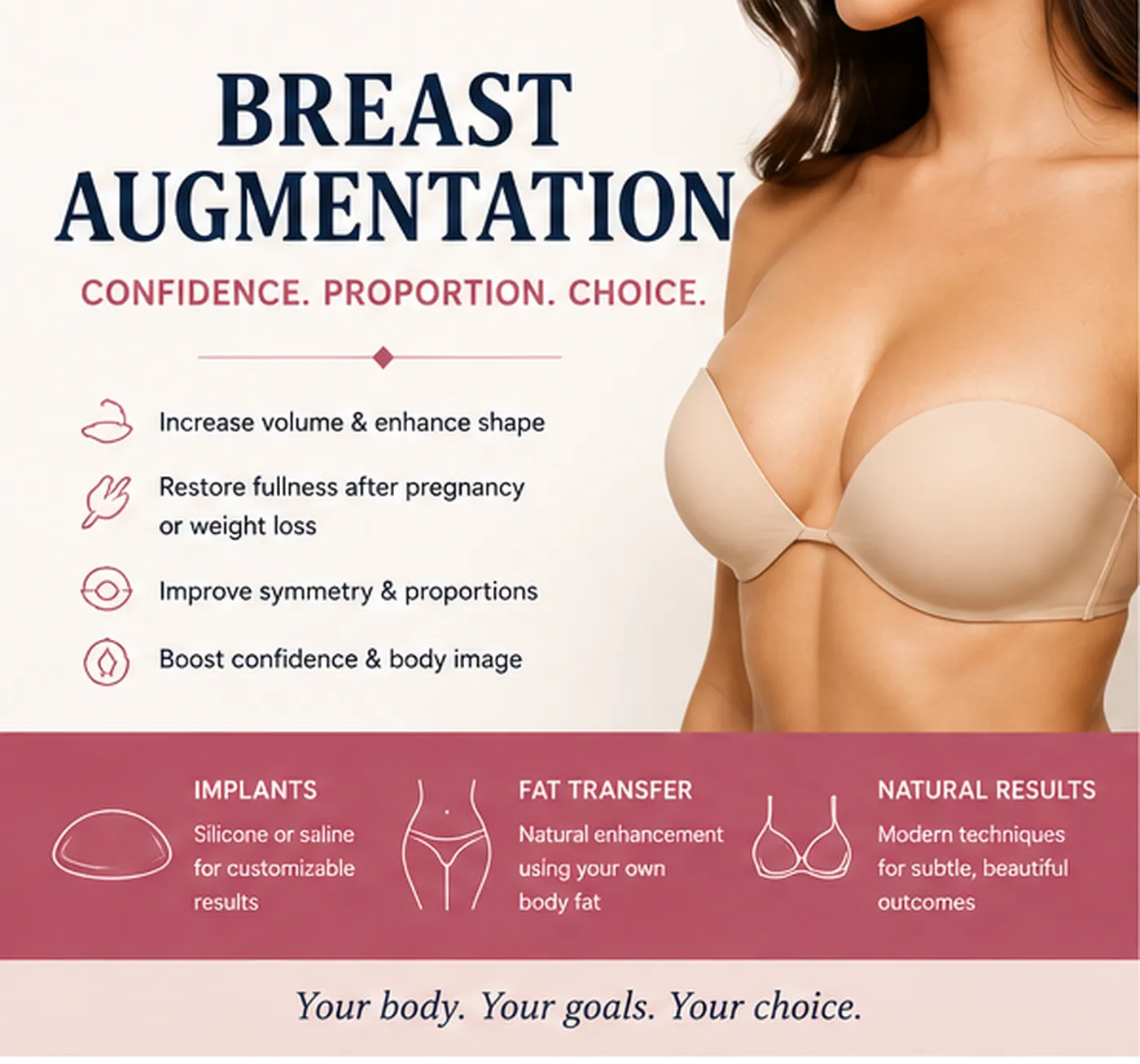
Breast augmentation is cosmetic surgery performed to increase breast volume, change breast shape or improve overall breast proportions using implants, transferred body fat or a combination of both. It is also commonly called breast enlargement, breast enhancement or, less formally, a boob job.
The goal isn’t always a dramatic size increase. Breast augmentation can be used for anything from a subtle change in fullness to a much more noticeable transformation.
Common reasons people consider breast augmentation include:
- Increasing breast size or volume
- Restoring fullness lost after pregnancy or weight loss
- Improving visible breast asymmetry
- Adding upper-breast fullness
- Changing breast projection or overall shape
- Creating better balance between the chest, waist and hips
One thing augmentation does not automatically fix is significant sagging. When breast position is the bigger issue, a breast lift may be performed instead of—or together with—augmentation.
Breast Implants vs. Fat Transfer: What Are the Main Options?
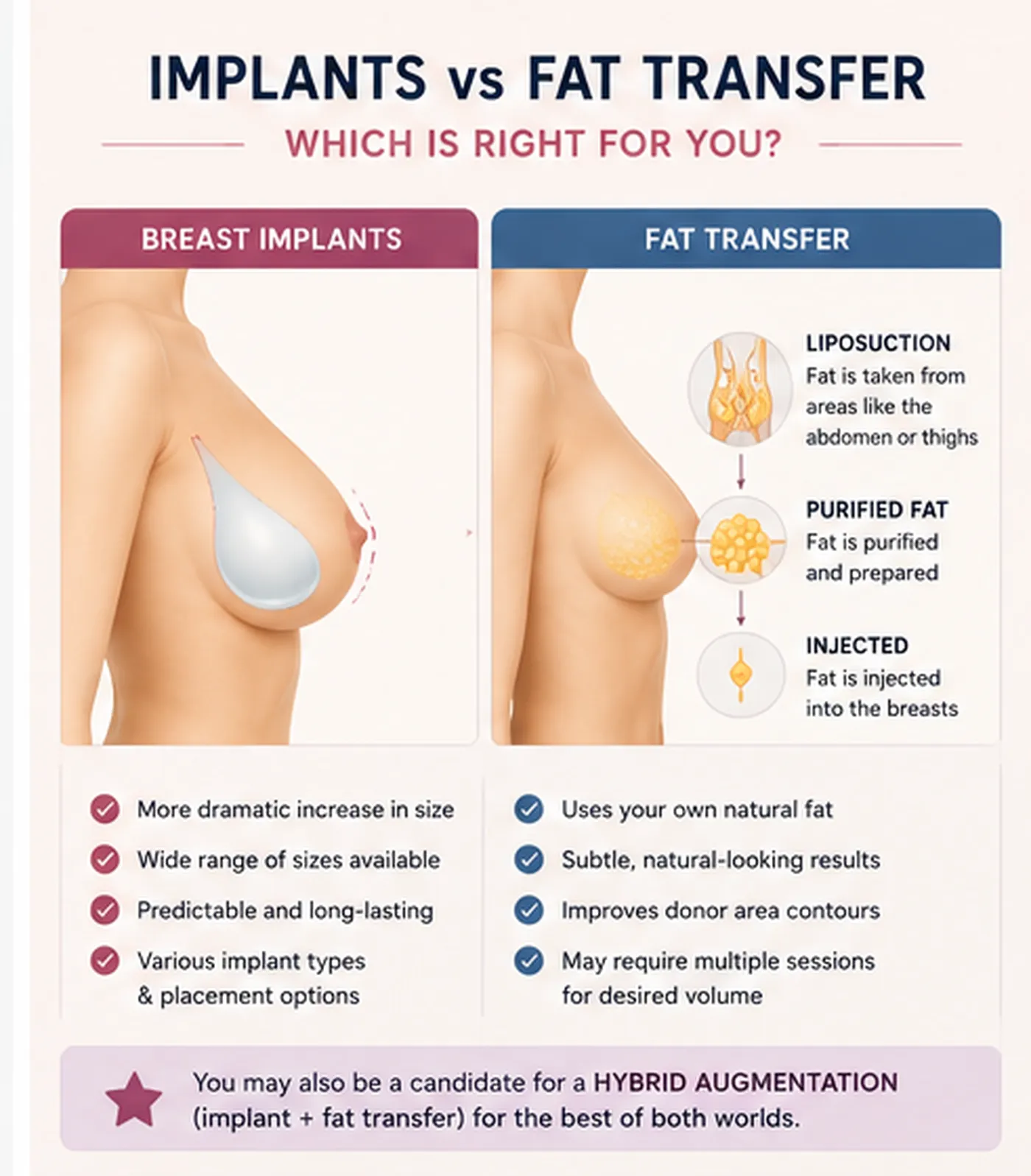
The two main approaches to breast augmentation are breast implants and fat transfer. Implants generally provide more predictable volume, while fat transfer uses a person’s own body fat for a usually subtler increase.
Breast Implants
Implants remain the classic option. A medical implant is placed beneath breast tissue or in a deeper position involving the chest muscle to add volume and influence shape.
The two major implant-fill categories in the United States are:
- Silicone gel implants – filled with silicone gel.
- Saline implants – filled with sterile saltwater inside a silicone shell.
Fat Transfer Breast Augmentation
Fat transfer takes fat from another area—often the abdomen, flanks or thighs—using liposuction and transfers selected fat into the breasts. Think of it as body contouring and breast enhancement meeting in the middle.
Fat transfer is particularly associated with subtle, natural-looking volume. It usually cannot create the same predictable size increase that implants can, and some of the transferred fat does not remain permanently.
Hybrid Breast Augmentation
And then there is the increasingly interesting middle ground: an implant plus fat transfer. A smaller implant can provide predictable structure while transferred fat helps soften edges and fine-tune shape.
This combination is sometimes called hybrid or composite breast augmentation—and it fits perfectly into today’s “did she or didn’t she?” aesthetic.
Silicone vs. Saline Breast Implants: What’s the Difference?
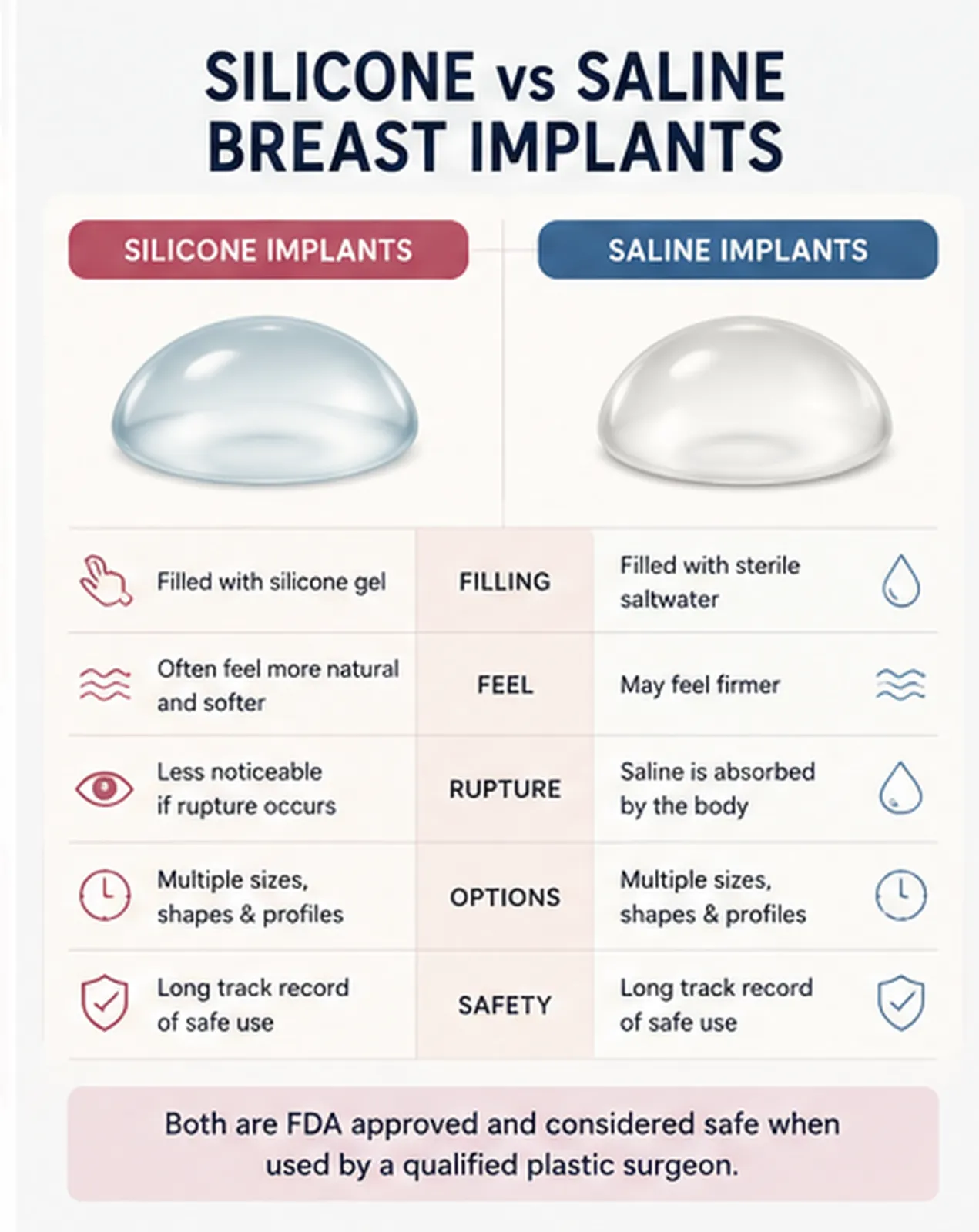
Silicone implants contain silicone gel, while saline implants contain sterile saltwater inside a silicone shell. Both can increase breast volume, but their feel, behavior and available options differ.
Silicone implants tend to dominate modern breast augmentation discussions because many patients are looking for a softer, natural-feeling result. Saline implants remain another established option and can be filled during the operation.
- Silicone implants: silicone outer shell filled with silicone gel.
- Saline implants: silicone outer shell filled with sterile saline.
Implants can also vary considerably in size, profile, shape and surface. That means choosing an implant is considerably more complicated than simply saying, “I’ll take 300cc.”
A high-profile implant on one body may create a completely different look than the same volume on someone with a wider chest. Breast augmentation is ultimately about proportions—not just numbers.
Over the Muscle or Under the Muscle: Where Do Breast Implants Go?
Breast implants can be positioned above the chest muscle, below it or using techniques that involve partial muscle coverage. Implant position can influence the final shape, visibility of the implant and recovery experience.
The two terms you will hear most often are:
- Subglandular / over the muscle – the implant sits behind the breast tissue and above the pectoral muscle.
- Submuscular / under the muscle – the implant is positioned beneath the chest muscle.
Neither automatically creates the “best” breast augmentation result. Existing breast tissue, chest shape, implant choice, lifestyle and desired look all influence which approach may be selected.
This is another reason celebrity implant speculation based purely on photos gets shaky. Two women can have the same implant volume and look dramatically different because the underlying anatomy and surgical choices are not the same.
Breast Augmentation Before and After: What Actually Changes?
Breast augmentation before-and-after photos usually show changes in breast volume, projection, upper fullness, symmetry and the overall relationship between the chest and body. The most successful comparison is not necessarily the one with the biggest size difference.
Look beyond cup size and you may notice:
- More upper-pole fullness.
- Greater forward projection.
- A different cleavage line.
- Improved left-to-right balance.
- A fuller appearance after pregnancy or weight loss.
- A change in how the waist and hips appear in proportion to the chest.
Early postoperative photos can also be misleading. Implants may initially sit higher and the breasts may look tighter or more swollen before the final appearance settles.
ASPS even uses the wonderfully non-medical phrase “drop and fluff” to describe the gradual settling process that can continue for several months. In other words, week-one boobs are not necessarily month-six boobs.
Why Smaller Breast Implants Are Having a Big Moment in 2026
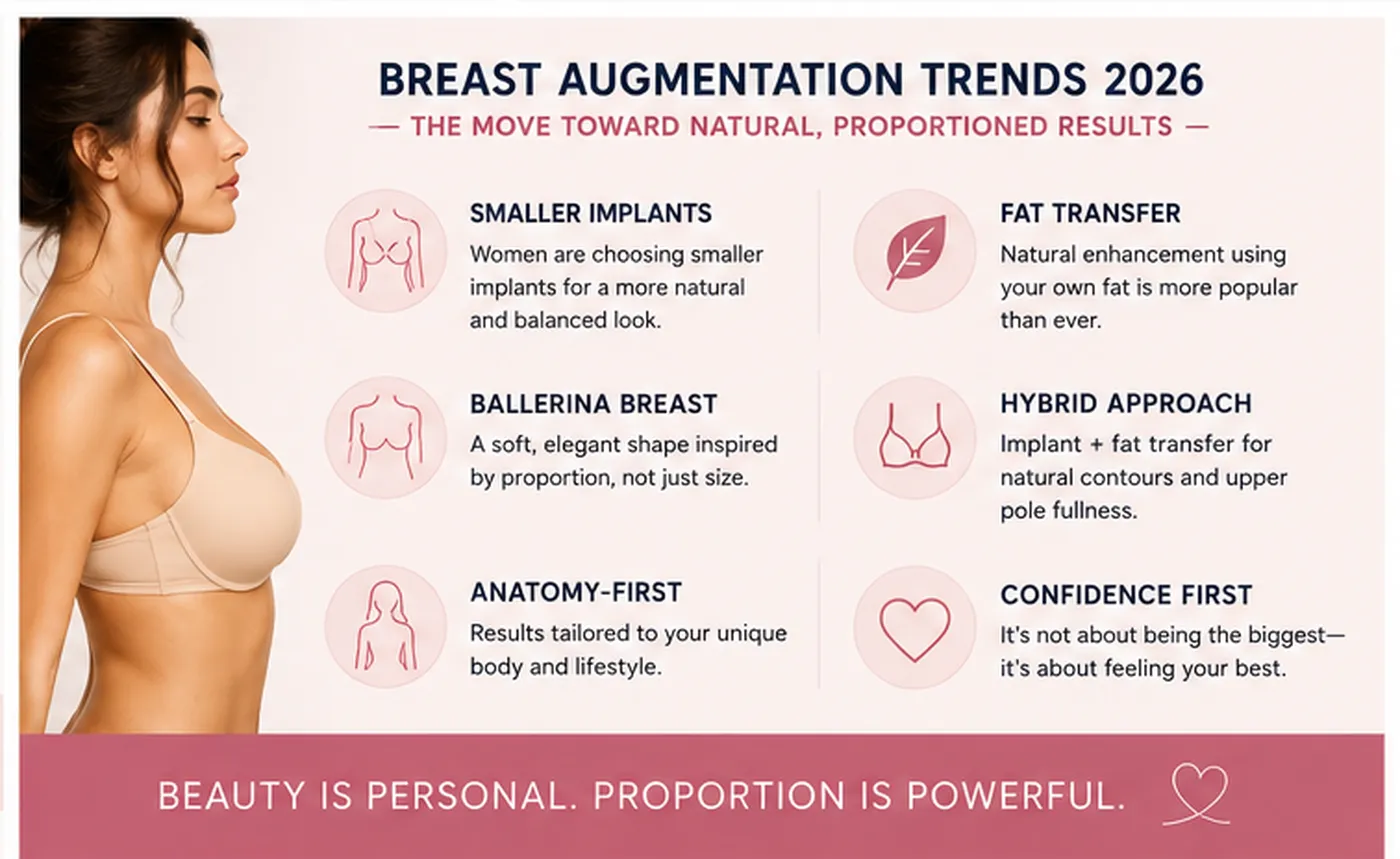
One of the clearest breast augmentation trends in 2026 is a shift toward smaller implants, balanced proportions and results designed to look more natural on the individual’s frame. The aesthetic conversation is moving from maximum volume to maximum harmony.
In July 2026, the American Society of Plastic Surgeons highlighted the growing “ballerina breast” trend—a look built around elegance, proportion and refinement rather than dramatically oversized breasts.
The current breast augmentation buzzwords tell the story:
- Smaller implants
- Natural breast augmentation
- Subtle enhancement
- Athletic proportions
- Fat transfer
- Hybrid breast augmentation
- Anatomy-first results
- Implant downsizing
The goal is not necessarily “small breasts.” It is a result that looks intentionally proportioned to the rest of the body.
Some women with older, larger implants are even moving in the opposite direction from their original surgery—downsizing, exchanging implants or removing them entirely. Plastic surgery trends really do come full circle.
How Popular Is Breast Augmentation?
Breast augmentation remains one of the most frequently performed cosmetic surgeries in the United States. According to the latest ASPS annual statistics currently available, 306,196 breast augmentation procedures were performed in 2024.
That placed breast augmentation at #2 among cosmetic surgical procedures, behind only liposuction.
- Liposuction – 349,728 procedures
- Breast augmentation – 306,196 procedures
- Tummy tuck – 171,064 procedures
- Breast lift – 153,616 procedures
- Eyelid surgery – 120,755 procedures
Breast augmentation also increased about 1% compared with 2023. That may sound modest, but maintaining growth for a relatively expensive elective surgery during economic uncertainty says plenty about its staying power.
The implants aren’t disappearing. The desired look is simply evolving.
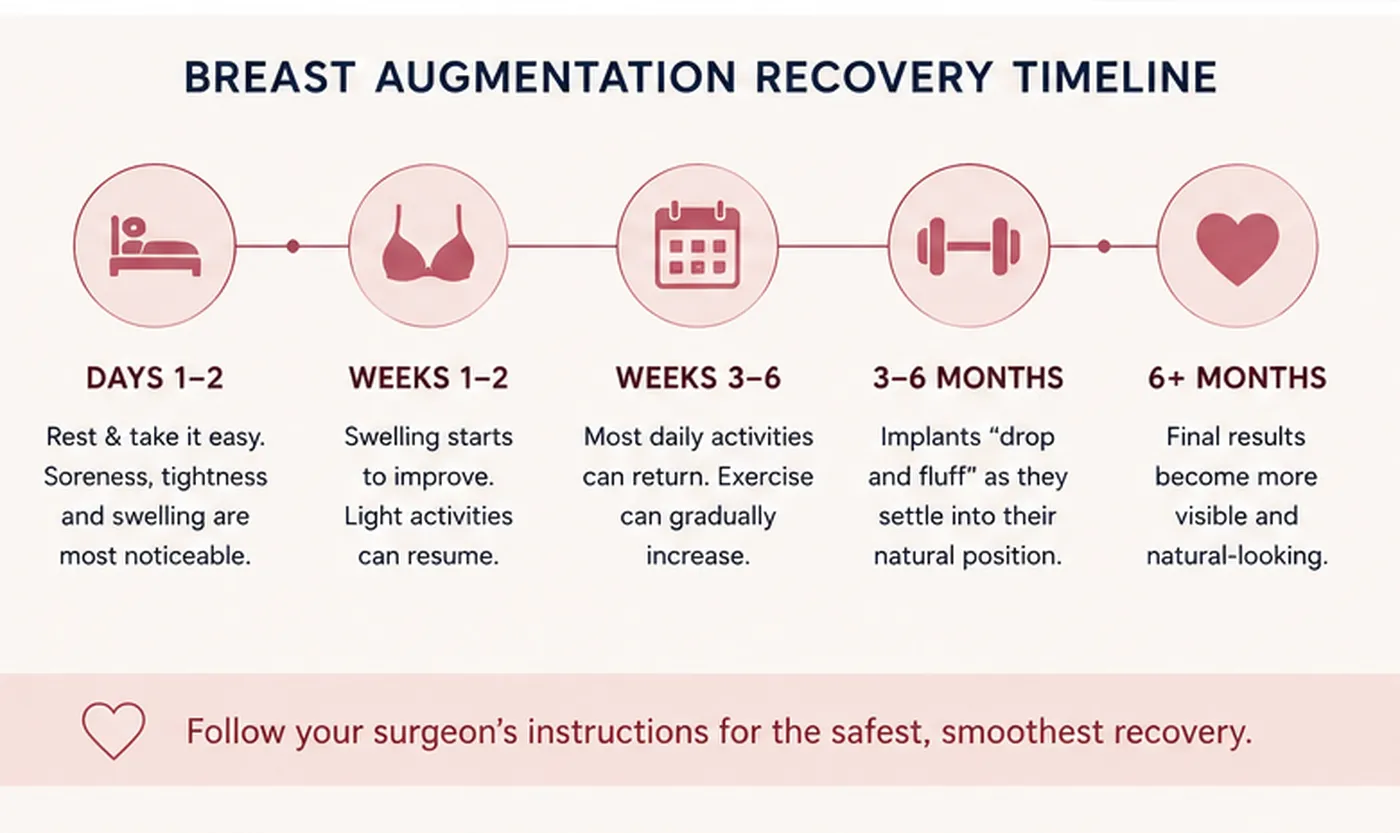
How Long Does Breast Augmentation Recovery Take?
The most uncomfortable stage of breast augmentation recovery is generally concentrated in the first days, while soreness and swelling can continue for several weeks and the final appearance takes longer to settle. Recovery varies depending on the operation, implant placement and the individual.
ASPS says acute pain commonly decreases after roughly one to five days, although soreness and swelling may remain for a few weeks.
A simplified timeline might look like this:
- First few days: soreness, swelling, tightness and limited activity are common.
- First few weeks: visible swelling gradually decreases and daily life becomes more normal.
- Following weeks: activity can gradually increase according to postoperative instructions.
- Following months: implants continue settling and the breast shape becomes more representative of the long-term result.
This also explains why judging a celebrity’s supposed boob job from photos taken a few weeks apart is questionable detective work. Breast shape changes throughout the recovery process.
How Much Does Breast Augmentation Cost?
Breast augmentation cost varies by surgeon, location, implant choice and surgical complexity. ASPS’s latest 2024 fee data lists surgeon or physician fees of approximately $4,575 to $8,000 for implant-based breast augmentation.
For breast augmentation using fat grafting without implants, the reported surgeon-fee range is approximately $5,500 to $9,500.
Those figures are not necessarily the entire bill. Additional expenses can include:
- Anesthesia.
- Operating room or surgical facility fees.
- Breast implants.
- Medical testing.
- Postoperative garments.
- Prescriptions.
- Other case-specific expenses.
The cheapest quote is therefore not automatically the cheapest final procedure. Comparing breast augmentation prices without checking what each price includes can be like comparing airline tickets before baggage fees appear.
Are Breast Implants Permanent?
Breast implants are not considered lifetime devices, and some people eventually undergo additional surgery to replace, revise or remove them. There is no universal expiration date at which every implant suddenly needs to be replaced.
Reasons someone might later have another breast operation include:
- Wanting a different implant size.
- Changing aesthetic preferences.
- Implant rupture or deflation.
- Capsular contracture.
- Implant position changes.
- Changes caused by pregnancy, aging or weight loss.
- Choosing implant removal.
This has created an entire second chapter of modern breast augmentation culture: implant revision, downsizing and explant surgery.
A celebrity who openly had implants in her twenties may not necessarily have the same implants—or even implants at all—fifteen years later. Before-and-after timelines can be far more complicated than “before implants” and “after implants.”
What Can Go Wrong With Breast Augmentation?
Breast augmentation can have both cosmetic and implant-related complications, and some problems can lead to additional surgery. Commonly discussed issues include capsular contracture, implant rupture, asymmetry, pain, position changes and dissatisfaction with the final appearance.
Capsular contracture happens when scar tissue around an implant tightens more than expected, potentially making the breast feel firmer or changing its shape.
Other possible issues include:
- Implant rupture or saline implant deflation.
- Changes in breast or nipple sensation.
- Visible implant wrinkling or rippling.
- Implant displacement or poor position.
- Infection.
- Asymmetry.
- Scarring.
- Need for revision surgery.
There are also rarer implant-associated conditions that receive considerable attention, including BIA-ALCL, a type of lymphoma associated particularly with textured implant surfaces. The FDA says the risk is higher with textured implants than with smooth implants.
And then there is the much-discussed term breast implant illness (BII). The FDA says some patients report systemic symptoms under that label, but the cause and exact relationship to implants remain unclear and BII is not currently a formal medical diagnosis.
The 2026 breast augmentation shift: The conversation is moving away from “How big can I go?” and toward “What actually fits my body?” Smaller implants, fat transfer, hybrid techniques and subtler proportions are turning breast augmentation into less of a size contest and more of a balancing act.
Breast Augmentation FAQ
Is breast augmentation the same as breast implants?
Not exactly. Breast augmentation is the procedure or goal of increasing breast volume, while breast implants are one method used to achieve that goal.
Can you get breast augmentation without implants?
Yes. Fat transfer breast augmentation uses a person’s own fat instead of implants. The approach is generally better suited to subtler volume changes than a large increase in breast size.
What are the main types of breast implants?
The two main implant-fill categories approved in the United States are silicone gel and saline. Both use a silicone outer shell but contain different filling material.
Which looks more natural: silicone implants or fat transfer?
There is no universal answer because natural appearance depends heavily on anatomy, volume and technique. Fat transfer is commonly associated with subtle enhancement, while appropriately selected smaller implants can also create very understated results.
Can breast augmentation fix sagging breasts?
Augmentation can add volume, but it does not perform the same job as a breast lift. Significant sagging or nipple-position changes may lead to discussion of a breast lift alone or a lift combined with augmentation.
How long does breast augmentation recovery take?
Most obvious discomfort is concentrated early, but soreness and swelling may last several weeks. The breasts and implants may continue settling for months before the final look becomes clear.
How much does breast augmentation cost?
ASPS’s 2024 national data lists surgeon fees of roughly $4,575 to $8,000 for implant-based augmentation. Facility, anesthesia, implant and other costs may increase the total price.
Do breast implants need to be replaced every 10 years?
There is no automatic ten-year replacement rule for every implant. However, the FDA stresses that breast implants are not lifetime devices and some people will eventually require another operation.
Can breast implants rupture?
Yes. Both saline and silicone implants can rupture, although the way a rupture appears and is detected differs between the two.
Are smaller breast implants becoming more popular?
Yes, natural-looking and smaller-volume augmentation is a notable 2025–2026 trend. ASPS has highlighted smaller implants, fat transfer and proportion-focused “anatomy-first” results as major directions in contemporary breast surgery.
Breast Augmentation Isn’t Going Away—But the “Perfect” Look Is Changing
Breast augmentation remains one of the world’s defining cosmetic surgeries, but the modern goal is becoming increasingly personal. The oversized, one-look-fits-all breast augmentation era has more competition than ever from smaller implants, fat transfer and results built around individual proportions.
That shift also makes before-and-after photos more interesting. Sometimes the most successful transformation is dramatic; other times you notice a better silhouette without immediately realizing why.
Explore our other plastic surgery procedures, including rhinoplasty, facelift, liposuction and breast surgery—or dive into our celebrity plastic surgery before-and-after stories to see how breast implant rumors, confirmations, removals and transformations have played out in the spotlight.
————–